FB Food Safety · November 2026 Industry Brief
November Food Safety Brief: Practical Checks for Your Team
Less headline overload. More practical prevention. Turn this month’s food-safety news into the next useful conversation with your team.
By Fay Gregory · Companion to our November broadcast
01 / Outbreak reporting
Read beyond the headline.
San Luis Obispo County’s November 6 update on the Shiga toxin-producing E. coli investigation associated with Brookshire Farms included 15 people, with five laboratory-confirmed cases.
Important context: The county reported no ongoing threat from the outbreak. An investigation update is not automatically a warning of continuing exposure.
Ask your team: Who records illness complaints, preserves traceability information and escalates concerns under your procedures?
02 / Supplier controls
Look beyond the receiving dock.
FDA’s California Longitudinal Study examines how environmental factors contribute to the introduction, persistence and movement of foodborne pathogens before harvest. Findings describe STEC in livestock and wildlife feces, water, sediment and other sampled materials, with some strains persisting over time.
Ask your team: Do produce-supplier reviews consider relevant water, weather, adjacent-land-use and animal-activity risks? A receiving inspection does not tell the whole story.
This study provides background—not proof of any particular outbreak’s source, and not the specific runoff-modeling paper referenced in the newsletter. Read FDA’s study →
03 / Chemical handling
Unknown container? Stop.
WBTV, citing the Foothills Health District, reported that three customers and two employees suffered chemical burns after a granulated degreaser was mistaken for sugar at a Chili’s in Forest City, North Carolina. The chemical was reportedly in an unlabeled container.
The incident occurred October 28. The report states that the restaurant’s permit was reinstated October 29.
Three checks to make today
- Label: Correctly identify every chemical container.
- Separate: Keep chemicals away from food and drink ingredients.
- Escalate: Isolate and report unidentified substances. Never taste them.
Include contractors and temporary staff. Follow incident procedures and seek appropriate emergency help if exposure occurs.
04 / Product watch
Check the product. Check the lot.
Match inventory against the brand, size, lot and dates in each current notice. These summaries are not complete recall instructions.
Fresh To You sandwiches
Specific Sausage, Egg & Cheese Biscuit Sandwiches distributed in Oregon and Washington were recalled by Fresh & Ready Foods. No illnesses were reported in the notice.
Betterballen products
FSIS flagged sesame and, in the beef product, anchovy (fish) in certain products sold by Lowlands House. This was an alert—not a recall—because products were no longer for sale, but could remain in refrigerators or freezers.
Ground cinnamon
FDA’s November 4 update added a Wise Wife product to its ongoing alert. Long shelf life makes checking stored stock especially important.
Brad’s kale products
Certain Brad’s Crunchy Kale and Veggie Chips Kale products were recalled. The notice says to stop consuming and discard affected products—not return them.
Bring it to your next team meeting
Five checks. Clear ownership.
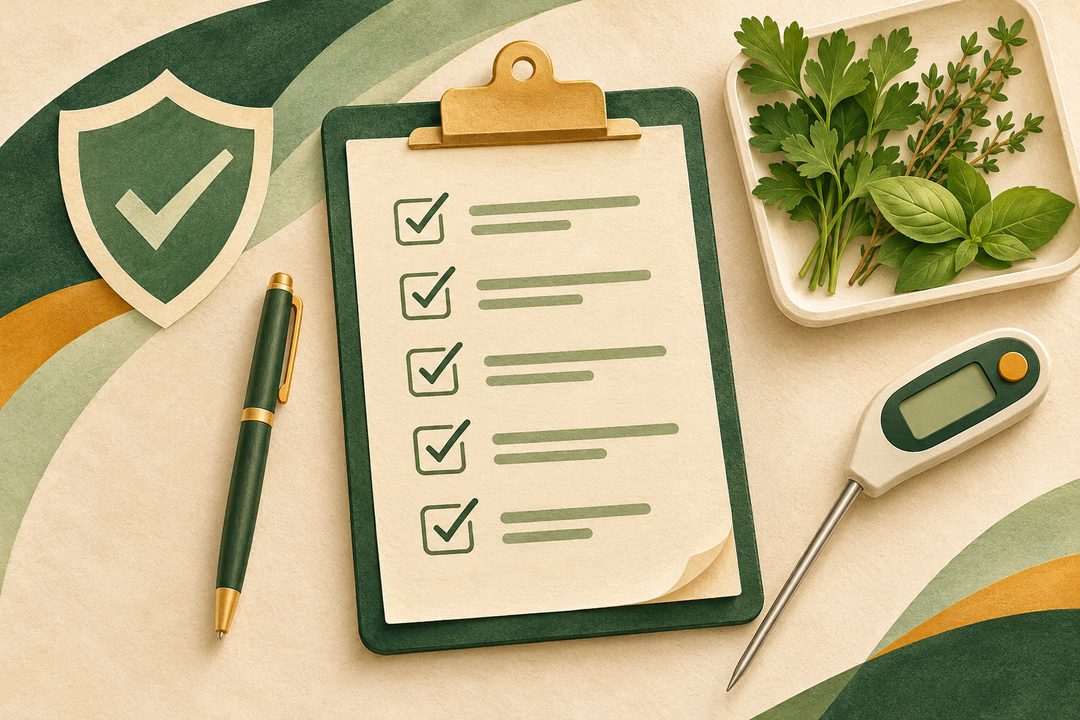
- Walk chemical-storage areas.
Check labels, containers and opportunities for confusion. - Assign alert ownership.
Know who monitors notices and checks affected stock. - Test traceability.
Trace an ingredient’s supplier, lot and use. - Revisit your hazard analysis.
Consider relevant biological, chemical and allergen hazards. - Close the loop.
Give each corrective action an owner and a verification step.